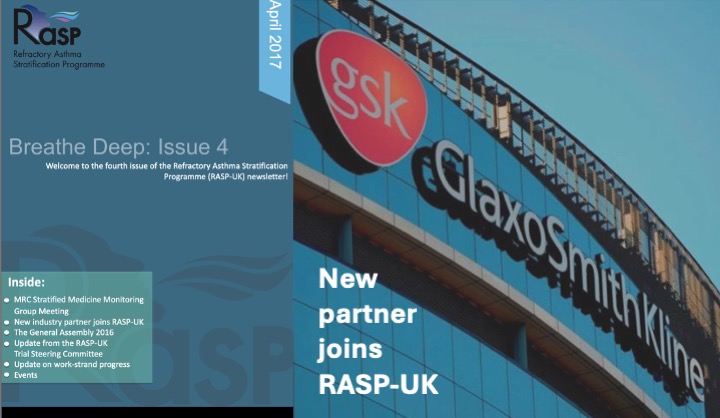

In its recent white paper on severe asthma, The Severe Asthma Report 2017, Asthma UK describes how action is urgently needed to improve the prospects for people with severe asthma. In the report they reveal the challenges of treating this complex condition and discuss how UK industry and researchers can lead the global challenge to develop accurate diagnostics and treatments for the global population of people with severe asthma. In the report Asthma UK describes how The Refractory Asthma Stratification Programme (RASP-UK) is leading the way. The study builds on the findings of U-BIOPRED and other biomarker-based research projects. This UK academic and industry collaboration aims to develop research and move away from the ‘one size fits all’ approach to treatment in severe asthma. Rather than continuing to use the stepped approach to treatment, which is based heavily on oral corticosteroids, the project aims to stratify treatments to different cohorts to reduce the stages that people have to go through to find an effective treatment. By studying the biomarkers of people who respond to corticosteroids and people who do not the project aims to predict who will and will not respond to corticosteroids, therefore enabling stratification to appropriate treatment at the outset rather than a trial of treatments over time.
The research which is already well-advanced will ensure that adherence and steroid response is considered as part of identifying the people who do not respond to treatment. This will make sure that the use of corticosteroids is optimised and people are not unnecessarily taking steroids, which patients have long stated as having long-term negative effects on health and lifestyle. The research will be undertaken through workstreams at centres around the UK, but patients will be stratified into two strands, one for populations who respond to steroids, the other for those who do not respond to steroids. For steroid responsive severe asthma there are already a number of treatments in the pipeline, however we know less about non-steroid responsive asthma and we need to speed up the development of new biologic treatments for these patients, a key aim of the RASP-UK consortium.
RASP-UK in a supported initiative from the MRC Framework for Stratified Medicine Research for the identification of key sub-groups of patients within a heterogeneous populations that might benefit from targeted treatments. In these circumstances research plays a critical role in shaping treatment guidelines for conditions like severe asthma by providing evidence-based data that can improve diagnosis, treatment, and management strategies. Here’s how research impacts these guidelines:
New Therapeutic Options
Improving Disease Understanding
Refining Treatment Algorithms
Reducing Side Effects and Enhancing Safety
Guiding Precision Medicine and Biomarker Use
Improving Patient Outcomes
In summary, ongoing research through the RASP-UK initiative aims to guide modifications to asthma treatment guidelines that are up-to-date with the latest scientific findings, providing healthcare professionals with the best available tools to manage severe asthma effectively. The process is iterative and driven by a combination of basic science discoveries, clinical trials, and real-world data analysis.


Get our latest news and publications
Sign up to our news letterResources
Social


Contact us
Address
Niche Science & Technology
Unit 26 Falstaff House
Bardolph Road
Richmond TW9 2LH
United Kingdom